In 1980, Canada, as a country, along with its distinct provinces, began procedural meetings with the intention of establishing its own Constitution. This nation, which had originally been under British influence especially through its monarch, sought to have its own identity and sovereignty as a country. Their desire was ultimately to institute a Charter of Rights and Freedoms for Canada to officially create its independence. A consent for the constitution was requested from Britain and in return the approval was accepted by their monarch. Queen Elizabeth II made the lengthy journey to visit our nation and on April 17th, 1982, she signed the Canada Act in Ottawa, Ontario, along with then Prime Minister, Pierre Elliott Trudeau. This gave Canada control over its Constitution and guaranteed the rights and freedoms of its citizens in the form of this Charter as the supreme law of the nation[1].

Now, for a moment, lets consider this momentous event in Canadian history and let’s imagine that one of us ordinary citizens was able to go back in time to April 17th, 1982. Let’s say we presented ourselves at the Parliament in our nation’s capital, for this critical occasion in our nation’s history to sign this declaration instead of Prime Minister Trudeau or Queen Elizabeth II. Imagine that we beat the signatories to the punch and signed our name on the dotted line. We might be right to assume that the addition of our signature to this document would mean very little, and quite honestly, if the signing of the charter happened in our day, we’d probably see protests flaring up and the eventual burning of the Charter. The point we’re trying to make is that the ones who sign the charter are also the ones who give it its legitimacy. The document’s validity is based upon who is backing it up and the weight of their title. Nothing short of a high-level bureaucrat, a prime minister or the Queen herself could have authenticated such a document.
The Text
Paul, an apostle of Christ Jesus by the will of God, To the saints who are at Ephesus and who are faithful in Christ Jesus: 2 Grace to you and peace from God our Father and the Lord Jesus Christ. (Ephesians 1:1-2)
The Prison Letter
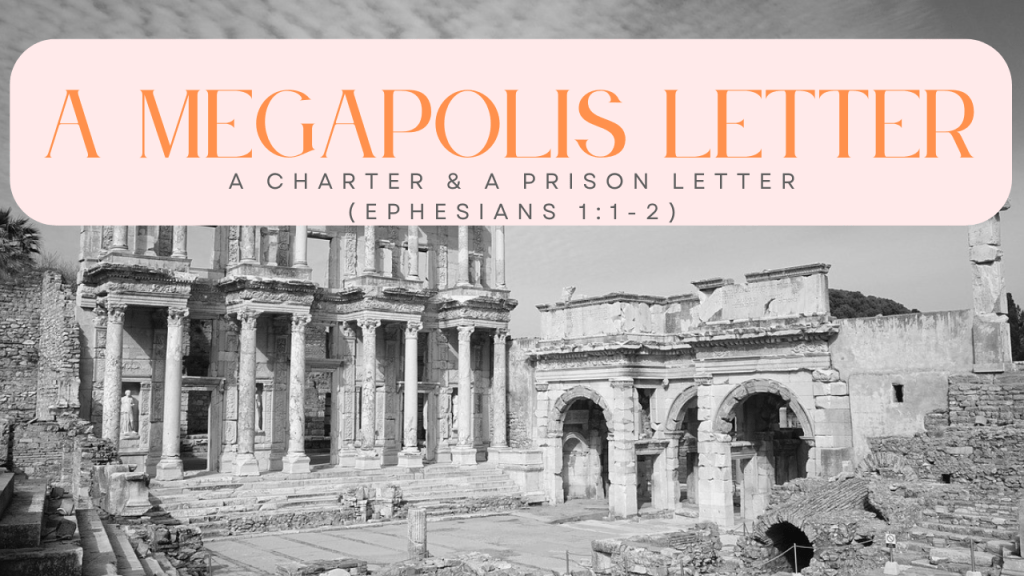
Written between A.D. 60-62, the man who penned this epistle, known as the apostle Paul, was at that time imprisoned in Rome (3:1; 4:1). The epistle to the Ephesians as it’s called, begins with a traditional introduction customary for first century letter writing where the author and recipients are named followed by a greeting. Much like the authentication of the Charter of Rights & Freedom, Paul establishes the authority behind the letter by declaring that he is an apostle of Christ Jesus. An apostleship that was established by the will of God, and in return gives the letter its substantiation. Why should the recipients of this epistle believe the content of the letter? Because its substance comes from a revelation of God to them at the hands of one of God’s representatives. An ambassador may speak on behalf of a government leader only if he’s been appointed by this official and given the authority to speak on his behalf. This letter really means nothing unless it comes from an authoritative source. Paul had been given this authorization. The apostleship of the followers of Christ was a divinely appointed office. There was a special designation for the original apostles known as “The Twelve” (Luke 6:11-16; John 6:67,70; 1 Corinthians 15:5) but being an apostle was not a privilege reserved for the 12 apostles (Matthew 10:2-4; Acts 1:13) who were eyewitness of His resurrection. The label is used in a wider sense for such people as Barnabas (1 Corinthians 9:5-7), Apollos (1 Corinthians 4:6,9), Silvanus or Timothy. They were men who had the task of representing Jesus Christ the Lord. Paul saw himself, however, as an equal with the twelve because he’d also seen the Lord visibly (Romans 1:1,5). It is generally thought that once the twelve went into eternity that the apostleship of the twelve ceased although some maintain that it is still alive today. The uniqueness to Paul’s apostleship is in that he was sent particularly as an apostle to the Gentiles. (Romans 11:13; Galatians 2:8). The title apostle of Jesus Christ is significant since Paul was given the authority to speak on Christ’s behalf. Paul was sent directly by King Jesus after His resurrection and ascension and only after the Lord of glory blinded him and commanded him to go (Acts 9:1-31).
By A Divine Will
His calling as an apostle was by the will of God. This wasn’t a matter of self-nomination, or a democratic vote, but it was by divine determination of God to appoint him to the task. Like the twelve, he was directly appointed by the Lord Jesus, the final direct appointee of this representative power. His commissioning shows that our Lord Jesus can even take a persecutor of His people and transform him as a servant for His purposes. If you think yourself to be too awful to be used by God, think again! God uses all sorts of people in all sorts of circumstances with a variety of backgrounds to accomplish His will.
To Ephesus?
The identity of the recipients of the epistle can be challenging to recognize depending on how we deal with the textual variant “in Ephesus”[2]. While certainly meant for the church in Ephesus, most agree that it was probably destined for several local churches. It is distinguished for its impersonal tone which lead many to believe that its destination was never meant uniquely for Ephesus. When we examine the scriptures that reveal the mission of the apostle Paul, we can’t help but notice that after spending 3 years in Ephesus, surely this would have wielded a more personal interaction with the Ephesian church (Acts 20:17-38). Some have even attributed the letter as intended for Laodicea for various reasons. The lack of personalization does at least hint that it may have been meant for a wider audience. It’s important to note that the letter was found in Ephesus and there is no evidence of it being at any other destination or attributed to another church. We can at least make the claim through the balance of probabilities and latter textual data that it was meant to be read by believers in Ephesus but perhaps elsewhere also. For our study, we’ll continue with the tradition of the Ephesian destination.
Saints
Regardless, the letter was written to saints who were faithful to Jesus Christ. The holy ones (saints) were blessed as a people and those who were set apart from the world. To be holy meant to be distinguished in a very special way. The people of God under the Old Testament were not simply referred to as a people, but as a holy people (Exodus 19:6) and a holy nation (Leviticus 19:2). These beneficiaries are described as faithful in Christ which denotes their identity as believers. They are those who find their unity by being brought together in Christ. The terms saints and faithful are deemed as almost synonymous in describing a people who are at the same time set apart and devotees. This expression “in Christ” will be explored much further in the following passages.
Paul opens the letter with a greeting coming from the Father and the Son, a word of blessing to communicate favour and of the great shalom from Yahweh[3]. Grace and peace were already a reality in the life of these believers, but Paul’s blessing demonstrates that there is a desire for them to experience them more abundantly.
In the Misinformation/Disinformation Age
We live in a time when the terms “misinformation” and “disinformation” have become prevalent lingo used by political rivals who are looking to win your trust. These civil elites are generally competing for your faith in them on any number of ideologies and policies by demonizing the other side’s information and evidence. We also live in a time when we are exposed to the danger of manipulation. This has come in the form of the media, social media and even in the communication that can be produced by artificial intelligence (A.I). The latter has generated incredibly sophisticated scams with its ability to deceive like no other time in history. It is almost impossible to really tell the difference between reality and deception which will only become more potent as the technology becomes more sophisticated.
But when we, as Christians, consider what information to trust, especially in this age, while seeking veracity and clarity, we must continue to go to the source of truth which is the word of God. The apostle Paul and other biblical writers were “inspired” and the words they penned were by nature God-breathed (2 Timothy 3:16) since they were not speaking on behalf of themselves but lead by the Holy Spirit (2 Peter 1:21). These are divine words coming from the mouth of a good and holy God. Jesus Himself also saw the words written in scripture as coming from the very mouth of God (Matthew 22:31). The words of scripture are meant to teach, reprove, correct and train in righteousness so that we may be equipped for every good word (2 Timothy 3:16-17). We must base our teaching, our ability to criticize untruths, to rectify misinformation and to train ourselves in God’s righteousness through the words of those Ambassadors who left for us their divinely appointed words. We can trust in the truthfulness of those words left to us. This should be the measuring stick by which we judge all other information.
[1] https://www.justice.gc.ca/eng/csj-sjc/rfc-dlc/ccrf-ccdl/learn-apprend.html#:~:text=In%201980%2C%20Canada%20and%20its,to%20develop%20the%20final%20Charter.
[2] The manuscripts that omit this phrase “at Ephesus” are P46, Aleph, B, 6, 424 and 1739.
[3] This is a similar pattern of greeting attributed to the apostle Paul: Romans 1:7; 1 Corinthians 1:3; 2 Corinthians 1:2; Philippians 1:2; 2 Thessalonians 1:2 etc.
 The Moncton Herald